

Baylor County Family District Court Information
| Information | Details |
|---|---|
| Location | Baylor County District Clerk’s Office, 101 S. Washington Street, Seymour, Texas 76380 |
| Contact | (940) 889-3322 |
| Operating Hours | 8:00 AM to 5:00 PM, Monday through Friday, excluding holidays |
| Security Checkpoints | Be prepared to pass through security checkpoints, which might take additional time. |
| Parking | Arrive early to secure parking; spaces near the courthouse can fill up quickly. |
| Advice | Allow ample time to manage unforeseen delays efficiently. |
Eligibility and Baylor County Requirements
In Baylor County, to file for divorce, one spouse must have lived there for at least six months. The common filing ground is “irretrievably broken,” a no-fault option that avoids assigning blame.
The 6-Month Texas Residency and 90-Day County Rule
In Texas, a divorce requires one spouse to have lived in the state for at least six months and in the filing county for 90 days. This ensures the case has a legitimate venue. If a spouse resides elsewhere, the filing spouse can proceed in their Texas county if they meet these criteria.
How to File for Divorce in Baylor County: Step-by-Step
Divorce in Baylor County demands understanding its legal timeline, starting from decision-making to filing. Key steps include gathering documents and choosing between court clerk services or online platforms, each with its own benefits.
Step 1: Preparing the Original Petition for Divorce
To prepare the Original Petition for Divorce, gather key information about both parties, including names, addresses, and employment details. Clearly state the grounds for divorce – no-fault or fault-based – as specified by Texas law. Include information about children, covering custody, support, and visitation. Detail requests for property division, alimony, and debt responsibility. Attach a legal description of any relevant real property. Depending on your situation, you might also need to complete additional forms like a Civil Case Information Sheet or an Affidavit of Indigency if you can’t pay court fees. A Child Support Information Sheet could be required if children are involved. Consulting an attorney can be wise for accuracy and compliance with Texas law.
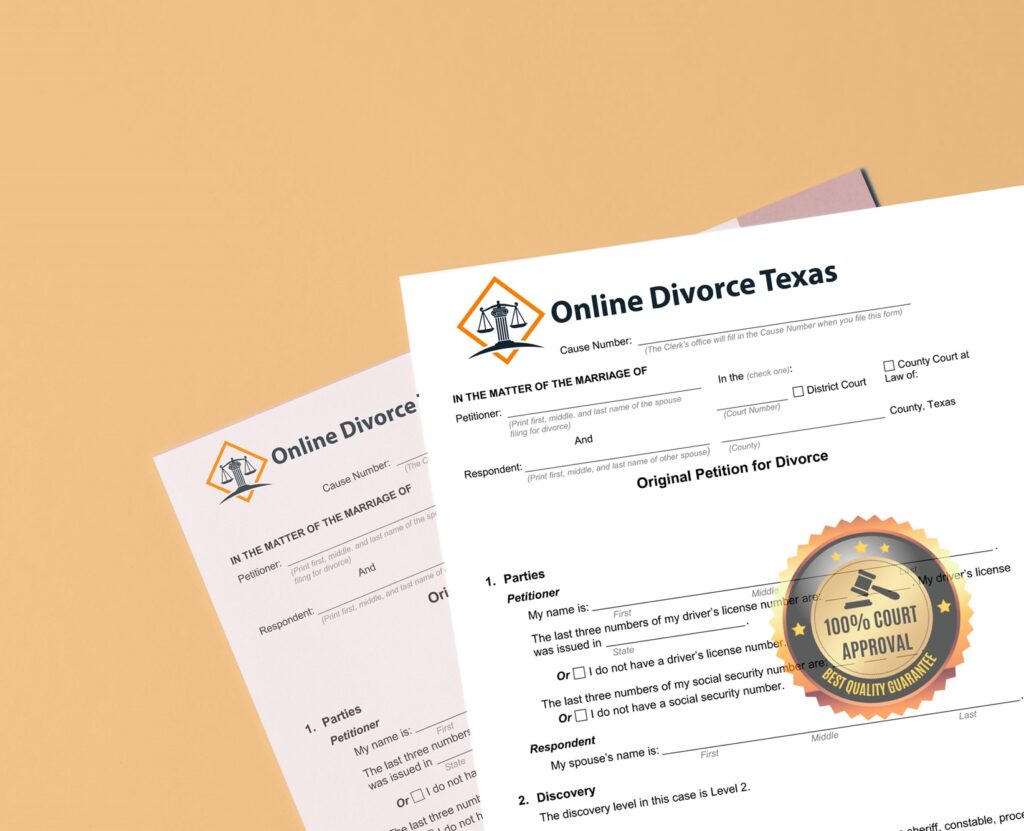
Create your free account to see if you’re eligible to file for online divorce in Texas. Complete all paperwork from the comfort of your home, with no hidden fees.
Step 2: Filing Fees and E-Filing via the District Clerk
The divorce filing fee in Baylor County is typically around $350. Check with the district clerk’s office for the exact amount. Use the Texas E-File website for electronic submission: create an account, select your county and court, upload your documents, and pay the fee. After submission, you’ll receive confirmation and can track your case.
Step 3: Service of Process and Waivers of Service
Official Notice via Citation involves delivering divorce papers to a spouse through a process server or sheriff to ensure legal acknowledgment. a Waiver of Service allows the spouse to voluntarily acknowledge receipt, bypassing formal delivery if notarized properly. Timeliness is very important to keep court schedules on track and prevent delays.
Requirements for Parents: The Parent Stabilization Class
In Baylor County, Texas, divorcing or separating parents must attend a mandatory, four-hour Parent Stabilization Class. This course imparts very important skills to reduce the negative effects of separation on children. The state-approved class ensures compliance with county guidelines. Parents receive a certificate upon completion, which must be promptly filed with the court to avoid legal delays and to show their dedication to their children’s well-being.
The 60-Day Waiting Period and Finalizing Your Case in Baylor County
In Baylor County, Texas, a 60-day wait is mandatory before finalizing a divorce from the petition filing date, allowing time for possible reconciliation or agreement finalization. If uncontested, the process concludes soon after this period. Disputes may require court-ordered mediation, where a neutral mediator aids in reaching a compromise, speeding up resolution.
Erin Bensen is a relationship expert and a writer known for her articles on love and marriage. Being a paralegal, she also writes about divorce and the procedures around it. Erin regularly contributes to Modern Love Counseling and other divorce blogs, offering practical advice and support. Right now, Erin is working on her personal podcast, where she intends to discuss the complexities of relationships and help couples considering divorce.