

Childress County Family District Court Information
| Step | Details |
|---|---|
| Location | Childress County District Clerk’s Office, 100 Avenue E NW, Childress, TX 79201 |
| Contact | (940) 937-6143 |
| Office Hours | 8:00 AM – 5:00 PM, Monday through Friday (excluding public holidays) |
| Parking | Arrive early as parking can be limited |
| Security | Be prepared to pass through security checkpoints |
| Tips | Allow extra time for security and planning your visit to ensure a smooth experience and efficient filing |
Eligibility and Childress County Requirements
In Childress County, to file for divorce, one spouse must live in the state for six months and in the county for 90 days. The no-fault standard simplifies the process; no need to prove wrongdoing like infidelity or abuse. Couples typically use the “irretrievably broken” reason to avoid public drama and speed things up.
The 6-Month Texas Residency and 90-Day County Rule
To file for divorce in Texas, a spouse must have lived in the state for at least six months and in the filing county for 90 days. If one spouse lives out of state, the Texas resident should still file in their home county. Jurisdictional issues, especially concerning children or property, will be managed per applicable laws like the UCCJEA.
How to File for Divorce in Childress County: Step-by-Step
Filing for divorce in Childress County requires going through a detailed legal process that starts long before submitting papers. You must prepare emotionally, gather documents, and understand legal requirements. Being informed about each stage of the process, from preparation to filing with the court clerk or online, ensures a smoother experience.
Step 1: Preparing the Original Petition for Divorce
To start the divorce process in Childress, prepare the Original Petition for Divorce. This document requests a divorce and outlines your intentions, including your names, marriage and separation dates, divorce grounds (fault or no-fault), and any property, debt, or child custody details. Include a Civil Case Information Sheet and a Standing Order for interim guidelines. Make two copies of all documents – one for your records, one to serve your spouse. Pay the filing fee at the courthouse or apply for a waiver if needed.
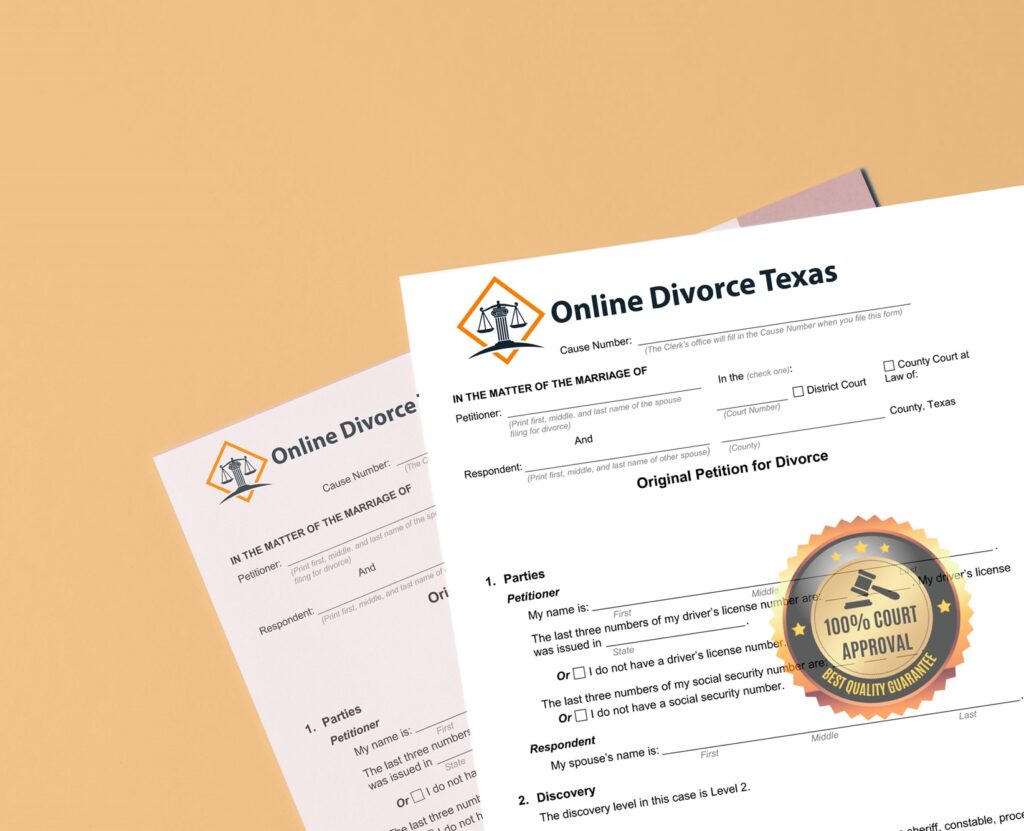
Create your free account to see if you’re eligible to file for online divorce in Texas. Complete all paperwork from the comfort of your home, with no hidden fees.
Step 2: Filing Fees and E-Filing via the District Clerk
To divorce in Childress, expect a filing fee around $350, though it’s best to confirm with the District Clerk’s office. Use the E-Filing system for convenience: create an account on the state’s portal, upload your completed divorce petition and documents, and follow instructions to ensure they’re correctly formatted. Pay the fee online and keep the confirmation as proof.
Step 3: Service of Process and Waivers of Service
Official Notice via Citation entails handing divorce papers to your spouse, confirming they’re informed about the proceedings, typically done by a sheriff or process server. a Waiver of Service lets your spouse voluntarily acknowledge receipt, bypassing formal delivery. This waiver must be signed under a notary to ensure authenticity, and should follow the filing of the petition.
Requirements for Parents: The Parent Stabilization Class
In Childress County, Texas, parents dealing with divorce or custody issues must take a mandatory Parent Stabilization Class. This course provides strategies to support their children’s emotional well-being during transitions. The class lasts at least four hours and must be conducted by a vendor approved by the county. After completion, participants receive a certificate, which must be filed with the relevant court as proof of compliance.
The 60-Day Waiting Period and Finalizing Your Case in Childress County
In Childress County, a 60-day waiting period starts once an uncontested divorce petition is filed, giving couples time to reconsider or reconcile. If disputes arise, mediation may be ordered, where a mediator helps resolve issues like child custody and property division.
Erin Bensen is a paralegal with experience helping people prepare Texas divorce paperwork and understand the divorce filing process. She helps people complete divorce petitions, understand court requirements, and identify the forms they may need for their county.
Erin provides document-preparation assistance and procedural guidance, not legal advice. Her goal is to make the divorce paperwork and filing process easier to understand for people who are filing on their own.