

Foard County Family District Court Information
| Process | Details |
|---|---|
| Location | Foard County Courthouse, 101 S Main St, Crowell, TX 79227 |
| Contact | (940) 684-1501 |
| Operating Hours | Monday to Friday, 8 AM to 5 PM (Call to confirm) |
| Parking | Arrive early to secure parking |
| Security | Be prepared for a security checkpoint, including metal detectors |
| Advice | Arriving early helps manage logistics and reduces stress |
Eligibility and Foard County Requirements
In Foard County, to file for divorce, one spouse must have lived in Texas for six months and in the county for 90 days. The county adopts a no-fault divorce policy, allowing couples to end their marriage without blame. Most choose the “irretrievably broken” ground, bypassing the need to prove fault, which simplifies the process and reduces stress, speeding up settlements.
The 6-Month Texas Residency and 90-Day County Rule
In Texas, one spouse must have lived in the state for six months, and in their county for 90 days, to file for divorce. If a spouse resides out of state, these residency rules still apply to the Texas resident. The petition can be filed in the Texas resident’s county, maintaining local jurisdiction.
How to File for Divorce in Foard County: Step-by-Step
Beginning a divorce in Foard County demands a clear grasp of the legal timeline. Start by organizing all necessary documents. Then formally file by submitting the paperwork to the court clerk, either in person or online, to lay the groundwork for a smoother process.
Step 1: Preparing the Original Petition for Divorce
To prepare the Original Petition for Divorce in Foard County, collect vital details like your spouse’s name, address, and information about children or property. Complete the standard Texas court form, available at the local courthouse or online. Specify the grounds for divorce, whether no-fault, like insupportability, or fault-based, such as adultery or cruelty. Indicate the desired arrangements for child custody, support, and property division. Include necessary documents like a standing order and an affidavit of indigency if you need a fee waiver. Review for accuracy to avoid delays. File the petition with the Foard County District Clerk, either in person or electronically, to officially kick off the divorce.
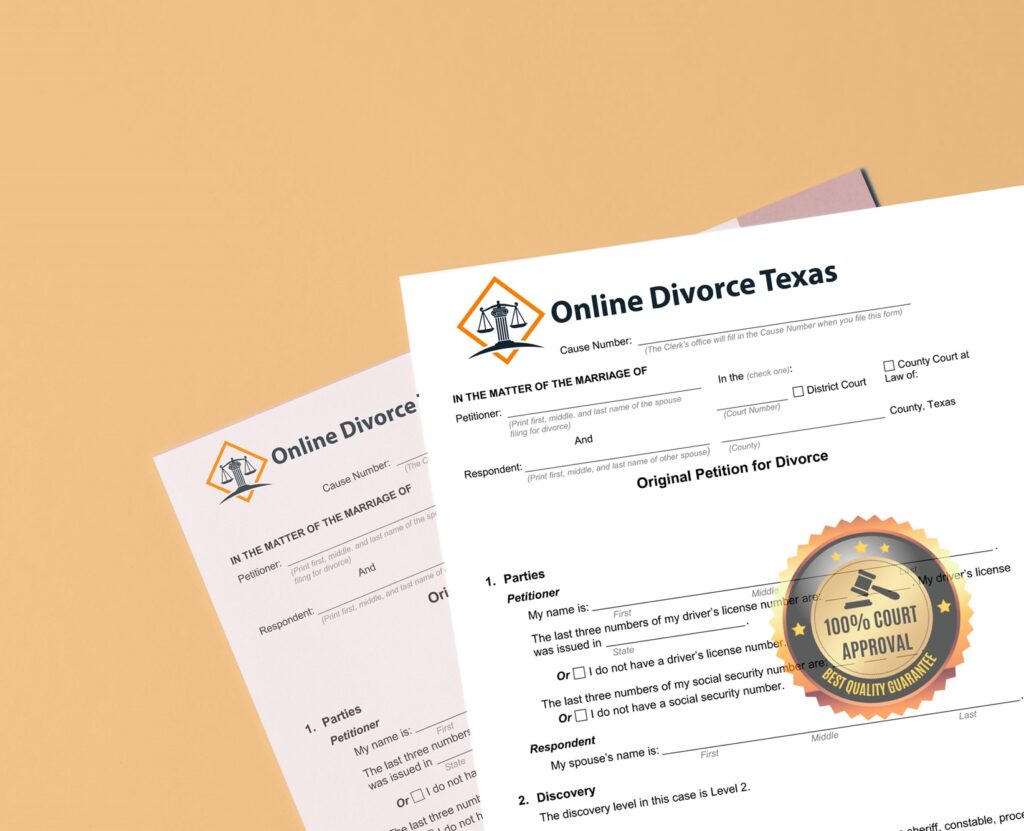
Create your free account to see if you’re eligible to file for online divorce in Texas. Complete all paperwork from the comfort of your home, with no hidden fees.
Step 2: Filing Fees and E-Filing via the District Clerk
To file for divorce in Foard County, pay a filing fee of about $350. Use the Texas E-Filing System to submit documents online via the state website or authorized providers. Create an account, select Foard County District Clerk, and follow the instructions to upload your completed forms and pay the fee electronically. After submission, the District Clerk reviews your documents and sends confirmation with additional steps. Make sure forms are accurate to avoid processing delays.
Step 3: Service of Process and Waivers of Service
In Foard, Texas, post-divorce filing, you must inform your spouse through a Service of Process, usually done with a citation. a Waiver of Service allows your spouse to voluntarily accept the divorce papers, possibly expediting the process. The waiver requires notarization to ensure its validity.
Requirements for Parents: The Parent Stabilization Class
In Foard County, Texas, parents involved in custody or divorce cases must attend a mandatory Parent Stabilization Class. This four-hour session, delivered by a state-approved vendor, provides essential tools for effective co-parenting and supporting children during family changes. Attendees receive a certificate to file with the court, proving their dedication to creating a stable environment for their kids.
The 60-Day Waiting Period and Finalizing Your Case in Foard County
In Foard County, Texas, there’s a required 60-day waiting period for uncontested divorces starting from the filing date, allowing time for reflection and possible reconciliation. For contested divorces, court-ordered mediation might be used to reach an agreement and avoid lengthy court proceedings. If mediation fails, a judge will decide the case’s outcome.
Erin Bensen is a paralegal with experience helping people prepare Texas divorce paperwork and understand the divorce filing process. She helps people complete divorce petitions, understand court requirements, and identify the forms they may need for their county.
Erin provides document-preparation assistance and procedural guidance, not legal advice. Her goal is to make the divorce paperwork and filing process easier to understand for people who are filing on their own.