

Fannin County Family District Court Information
| Step | Details |
|---|---|
| Location | Visit the Fannin County District Clerk’s Office, 101 E. Sam Rayburn Drive, Suite 200, Bonham, TX 75418. |
| Contact | Phone: (903) 583-7459 |
| Hours | Monday to Friday, 8:00 AM to 5:00 PM (call ahead for changes) |
| Security | Expect security checkpoints; they can be time-consuming. |
| Parking | Arrive early to secure parking as spaces may fill up quickly. |
| Tip | Early arrival ensures a smoother experience when filing documents. |
Eligibility and Fannin County Requirements
In Fannin County, to file for divorce, one spouse must have lived in Georgia for at least six months. The county uses a no-fault divorce standard, where neither party needs to prove misconduct, with “irretrievably broken” cited as the typical reason. This approach minimizes conflict and streamlines the process, aligning with the county’s goal of efficient and amicable resolutions.
The 6-Month Texas Residency and 90-Day County Rule
In Texas, to file for divorce, one spouse must have lived in the state for at least six months and in the filing county for at least 90 days. These requirements ensure the appropriate jurisdiction for handling the case. If one spouse lives out of state, the resident spouse can still file if these conditions are met, even if jurisdiction is contested.
How to File for Divorce in Fannin County: Step-by-Step
Filing for divorce in Fannin County demands a solid grasp of the legal process and timelines. Start by preparing essential documents and confirming residency requirements. This groundwork simplifies filing your case, whether in person or online, with the court clerk.
Step 1: Preparing the Original Petition for Divorce
To prepare an Original Petition for Divorce in Fannin County, gather essential details: full names, addresses, birthdates, and marriage date. Specify divorce grounds – either no-fault, such as insupportability, or fault-based, like adultery. Clearly state your requests for child custody, support, property division, and spousal maintenance, and list all debts and assets for fair distribution. Use standard forms from the Texas Law Help website or the district clerk’s office. Complete additional documents like the Civil Case Information Sheet and Proof of Service. Ensure you meet residency requirements: six months in Texas and 90 days in Fannin County. Consult an attorney for accuracy before filing with the district clerk.
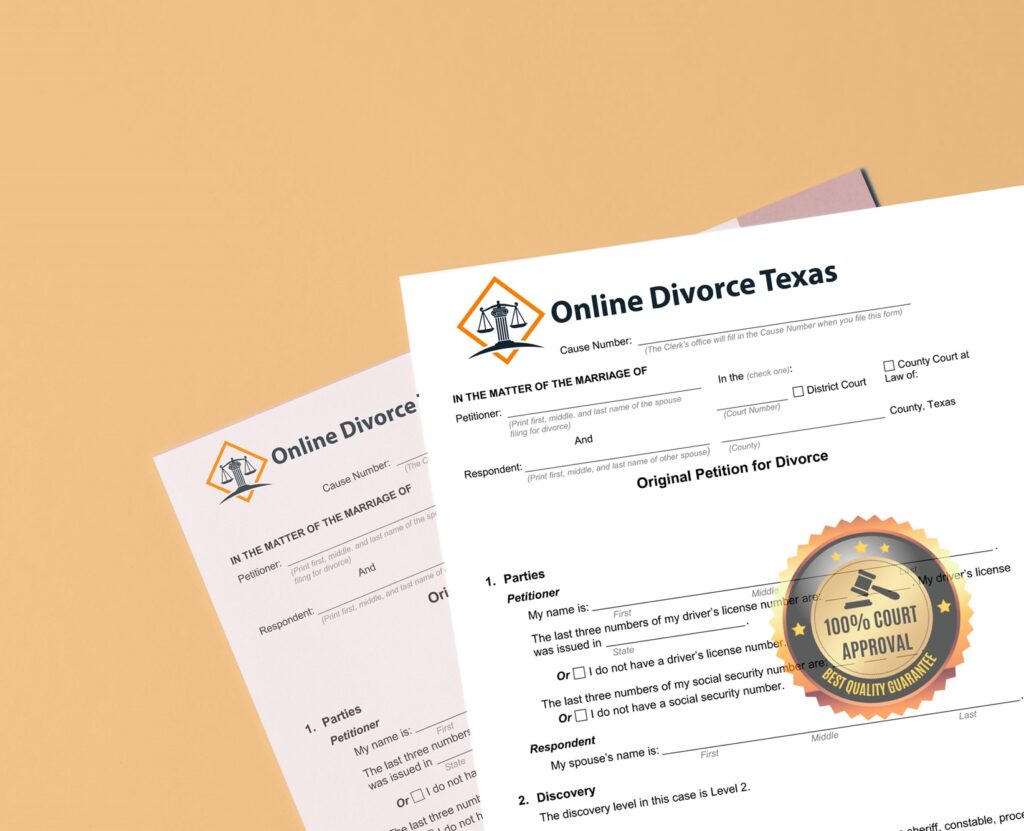
Create your free account to see if you’re eligible to file for online divorce in Texas. Complete all paperwork from the comfort of your home, with no hidden fees.
Step 2: Filing Fees and E-Filing via the District Clerk
Divorcing in Fannin County? It costs about $350. Use Texas’s E-Filing system: register with a certified provider, prepare your correctly formatted documents, log in, select Fannin County, and submit everything online while paying the fee. The District Clerk will then confirm receipt and guide you through any next steps.
Step 3: Service of Process and Waivers of Service
In Fannin, Texas, when filing for divorce, you must notify your spouse through an Official Notice via Citation delivered by a constable, sheriff, or authorized private process server. your spouse can sign a notarized Waiver of Service, acknowledging receipt of divorce papers and waiving formal notification. This accelerates the process but must be notarized. Your spouse generally has 20 days to respond, adhering to court schedules.
Requirements for Parents: The Parent Stabilization Class
In Fannin County, Texas, parents going through divorce or custody changes must attend a mandatory Parent Stabilization Class to help manage the impact on their children. This four-hour course, offered by a state-approved vendor, focuses on local issues to provide relevant guidance.
The 60-Day Waiting Period and Finalizing Your Case in Fannin County
In Fannin County, an uncontested divorce requires a mandatory 60-day waiting period starting when the petition is filed, allowing time for reflection and potential reconciliation. Contested cases with unresolved issues may result in court-ordered mediation to spread amicable agreements and avoid lengthy litigation. If mediation fails, the judge makes the final ruling. Understanding the timelines and legal steps helps ensure a smoother divorce process.
Erin Bensen is a paralegal with experience helping people prepare Texas divorce paperwork and understand the divorce filing process. She helps people complete divorce petitions, understand court requirements, and identify the forms they may need for their county.
Erin provides document-preparation assistance and procedural guidance, not legal advice. Her goal is to make the divorce paperwork and filing process easier to understand for people who are filing on their own.