

Hale County Family District Court Information
| Action | Details |
|---|---|
| Location | Hale County Courthouse, 500 Broadway Street, Plainview, TX 79072 |
| Contact | (806) 291-5261 |
| Hours | 8:30 AM – 5:00 PM, Monday – Friday, excluding holidays |
| Tips | Arrive early to find parking and allow time for courthouse security procedures. |
Eligibility and Hale County Requirements
In Hale County, to file for divorce, one spouse must have lived there for at least six months. The county’s no-fault standard allows couples to divorce without proving wrongdoing, commonly citing an “irretrievably broken” marriage.
The 6-Month Texas Residency and 90-Day County Rule
In Texas, to file for divorce, one spouse must have lived in the state for at least six months and in the filing county for 90 days. If one spouse lives out of state, the Texas resident can still file in their home county after meeting these requirements. The filing court generally has jurisdiction, but factors like the location of children and marital assets might affect venue decisions.
How to File for Divorce in Hale County: Step-by-Step
Going through divorce in Hale County may seem intimidating, but grasping the process simplifies it. Once you decide to divorce, preparation is key. Gather essential documents and information before filing, which you can do either in-person with the court clerk or online to kick off the official proceedings.
Step 1: Preparing the Original Petition for Divorce
To start a divorce in Hale, Texas, prepare the Original Petition for Divorce, outlining terms for child custody, property division, and spousal support. Include both spouses’ full names, contact information, marriage and separation dates, and the reason for divorce – no-fault or fault-based. Gather essential documents like a Waiver of Citation if your spouse agrees to expedite the process. Prepare a Temporary Restraining Order request if needed to protect assets and custody during proceedings. Attach financial affidavits detailing income, assets, and liabilities for clarity in property and support discussions.
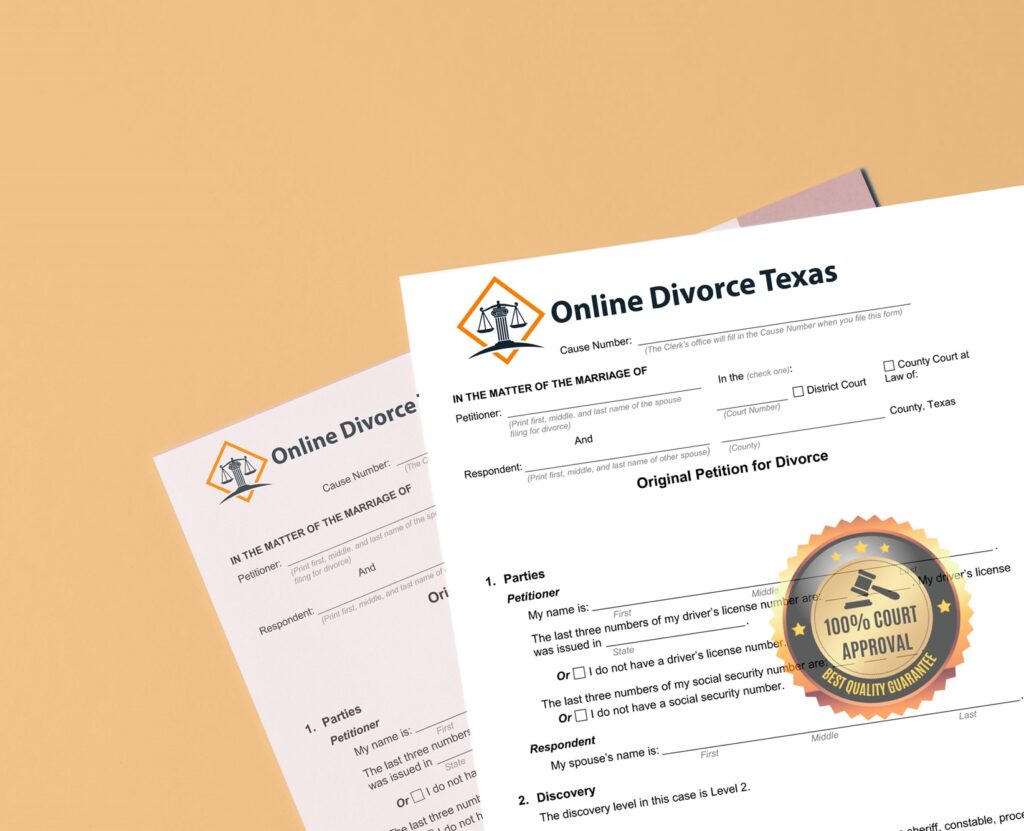
Create your free account to see if you’re eligible to file for online divorce in Texas. Complete all paperwork from the comfort of your home, with no hidden fees.
Step 2: Filing Fees and E-Filing via the District Clerk
The divorce filing fee in Hale is about $350, payable when you submit your paperwork to the District Clerk’s office. Hale offers E-Filing to simplify submissions. To use this system, register with an approved Electronic Filing Service Provider (EFSP) in Texas, then upload your divorce petition and documents through their platform. The District Clerk’s office will process your submission. Follow the EFSP and District Clerk’s instructions to avoid delays.
Step 3: Service of Process and Waivers of Service
In Hale, Texas, after filing a divorce petition, the other spouse must receive a Citation, officially notifying them of the legal action. they can sign a notarized Waiver of Service, accepting the petition without formal notification.
Requirements for Parents: The Parent Stabilization Class
In Hale County, Texas, divorcing or custody-disputing parents must attend a Parent Stabilization Class to learn about the effects of family changes on children and adopt healthier co-parenting methods. This county-specific, state-approved course runs for at least four hours.
The 60-Day Waiting Period and Finalizing Your Case in Hale County
In Hale County, a 60-day waiting period is mandatory for finalizing uncontested divorces. This starts when the divorce petition is filed, giving spouses time to reconsider. After this period, a judge can finalize the divorce if all agreements are settled. For contested cases, court-ordered mediation might be necessary to resolve disputes without lengthy litigation.
Erin Bensen is a relationship expert and a writer known for her articles on love and marriage. Being a paralegal, she also writes about divorce and the procedures around it. Erin regularly contributes to Modern Love Counseling and other divorce blogs, offering practical advice and support. Right now, Erin is working on her personal podcast, where she intends to discuss the complexities of relationships and help couples considering divorce.