

Hartley County Family District Court Information
| Step | Details |
|---|---|
| Visit Location | Hartley County Courthouse, 900 Main St, Hartley, TX 79044 |
| Contact | Call (806) 235-3582 for inquiries |
| Operating Hours | Monday – Friday, 8:00 AM – 5:00 PM (confirm hours ahead) |
| Parking | Limited; Plan to arrive early to find parking |
| Security | Be prepared for a security checkpoint; allocate extra time |
| Preparation | Arrive early to manage delays and ensure documents are in order |
Eligibility and Hartley County Requirements
In Hartley County, divorces are filed under the no-fault standard, meaning couples only need to declare their marriage irretrievably broken without proving wrongdoing. This approach is popular locally because it’s straightforward, speeds up the process, and reduces conflict.The 6-Month Texas Residency and 90-Day County Rule
To file for divorce in Texas, one spouse must have lived in the state for at least six months and in the filing county for a minimum of 90 days. These rules ensure cases are heard in the proper location. If one spouse lives out of state, the Texas resident can still file in their county, provided they meet the residency requirements. The court will oversee the in-state spouse, but property division and custody might need extra attention if the out-of-state spouse is less involved.How to File for Divorce in Hartley County: Step-by-Step
To file for divorce in Hartley County, it’s essential to grasp the legal process and timeline. Start by gathering necessary documents and understanding legal requirements. As you deal with emotional and logistical challenges, you’ll move to formally filing your divorce petition either at the local court clerk’s office or online. This step turns your intent into legal action.Step 1: Preparing the Original Petition for Divorce
To initiate a divorce in Hartley, start by preparing the Original Petition for Divorce. This document kicks off the legal process and covers requests for property division, child custody, and support. Include essential details like full names, addresses, birthdates, and marriage information, and state the grounds for divorce under Texas law, ranging from insupportability to fault-based reasons. Obtain necessary legal forms from the Texas state website or local courthouse, along with financial documents like pay stubs and tax returns for support claims. If you have children, fill out any required parenting plans. Review the petition for accuracy per Texas legal standards and notarize it if necessary.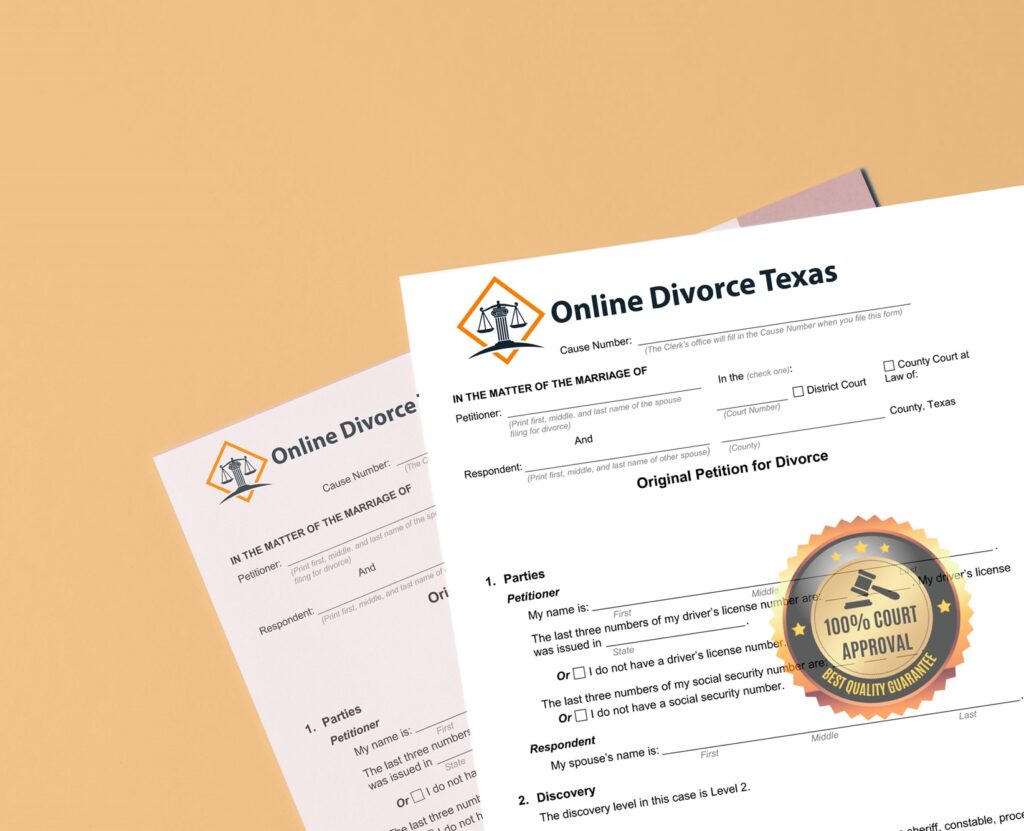
Ready to Begin Your Divorce?
Create your free account to see if you’re eligible to file for online divorce in Texas. Complete all paperwork from the comfort of your home, with no hidden fees.
Step 2: Filing Fees and E-Filing via the District Clerk
In Hartley, divorces cost around $350 to file. Use the District Clerk’s E-Filing system by registering on an approved site listed on the Texas Courts’ website. Fill out and upload the divorce petition forms, pay the fee electronically, and ensure your documents meet formatting standards. After submitting, you’ll get a confirmation email, and the District Clerk will provide a file-stamped copy of your petition, officially marking your case’s filing.Step 3: Service of Process and Waivers of Service
In Hartley, Texas, after filing a divorce petition, you must officially inform the other party with a citation via a process server or law enforcement. the respondent can sign a notarized Waiver of Service to acknowledge receipt voluntarily.Requirements for Parents: The Parent Stabilization Class
In Hartley County, Texas, separated parents must attend a four-hour Parent Stabilization Class. This state-approved course helps manage co-parenting stresses and maintain a stable environment for children. Parents should select a Hartley County-specific class to meet local legal codes. After completing the course, a Certificate of Completion is issued, which must be filed with the court.The 60-Day Waiting Period and Finalizing Your Case in Hartley County
In Hartley County, Texas, there’s a mandatory 60-day waiting period after a divorce petition is filed, even for uncontested cases, to allow time for reconciliation or amicable settlement. Contested issues might require court-ordered mediation, where a neutral mediator helps negotiate disputes. If mediation fails, the case goes to court for a judge’s decision. Mediation is generally less adversarial and cheaper than litigation.Erin Bensen is a paralegal with experience helping people prepare Texas divorce paperwork and understand the divorce filing process. She helps people complete divorce petitions, understand court requirements, and identify the forms they may need for their county.
Erin provides document-preparation assistance and procedural guidance, not legal advice. Her goal is to make the divorce paperwork and filing process easier to understand for people who are filing on their own.